

World Body
The Poetics of Jonathan Lyndon Chase

Is it worth it? Let me work it
I put my thing down, flip it and reverse it
Ti esrever dna ti pilf nwod gnaht ym tup i
Ti esrever dna ti pilf nwod gnaht ym tup i — Missy Elliott, Work It
Reorient, reconfigure and return. Often I feel like this is the journey we have to face as Black gay and trans people. The embodiment of living in the flesh of a Black queer body is a process of constantly having to reorient our bodies within space, time and gravity. It’s a doubled layered othering that is in a constant feedback loop that weaves through the noise and distortion of life. After we are fixed into a location, we then often have to reconfigure the place in which we inhabit in order to not have our threads be discombobulated. We reimagine and redress these places thus mastering the talent of world building and most times, the excess from this step, is fortified into a magic that we wield in the world usually through artistic expression. Finally, the last step of the process is that we must return as we fold back into ourselves, a recursive touch that brings us back to the true humanity of who we are as individuals and as a people. That’s why for many non LGBTQ people we often represent an authenticity, a truth and decolonized embodiment of humanness. This process isn’t to be romanticized. Unfortunately just as much as it is full of enlightenment, beauty it’s also a process that is twirls in a chamber, a cyclone of violence, grief and melancholy. It is a complex life that we live. Reorient, reconfigure and return.
— abdu mongo ali, Founder and Editor In Chief
It is great to see Black queer love across art, television, film, and literature. However, I’ve noticed a paradox, while the quantity of these representations has increased over the last fifteen years amid the zeitgeist of DEI, the diversity of experiences often feels narrower than in generations prior.
I struggle with the concept of “feeling seen” through another person’s art. That desire is understandably self-interested, but also, too comfortably self-centered. “Visiblity” has become a kind of cultural metric— success measured by how precisely a work mirrors our specific reality.
When that becomes the dominant practice of interpretation, craft gets sidelined. Careful cultivation, risk, and the execution of skill matter less than immediate recognition.We become conditioned to prioritize familiarity over multiplicity, which is a constant truth of our humanity.
Under that logic of “representation,”systems go unchallenged. New worlds remain unearthed. Instead, we get slight nuances added to familiar, and now overused, references. It’s time for something fresh, to build upon a cannon, not merely revere without the contextualization of a changed reality.
Black queer ancestors and elders worked without corporate or institutional support and without the parameters that support can impose. Their work lived in the world more directly, unmediated by the demand to translate itself into palatable and familiar forms. Their work was edited by peers and asked something of its readers, viewers, and participatory audiences.
By contrast, many contemporary outlets emphasize archetypal legibility. Patterns repeat; character profiles swap names while projecting the same narrative structure and relational dynamics. These expectations don’t stay on screen or on the page, they reverberate into our social realms. On social media, we see archetypes of couples and a limited selection of gay men elevated on pages curated toward conventional beauty. There are many gaps to fill if we want to tell a fuller story.
In Jonathan Lyndon Chase’s work, I see a variety of bodies, experiences and modes of relation. Working across media, they are able to translate a reality— making an intangible desire, feeling, or experience into visual containers for memory and connection. They externalize the inner realm and demonstrate the slippage of reality, informed by one’s own perception.
Our conversation looks at the unpinning of these aesthetic inclinations and the world that has shaped Jonathan’s approach to creation.
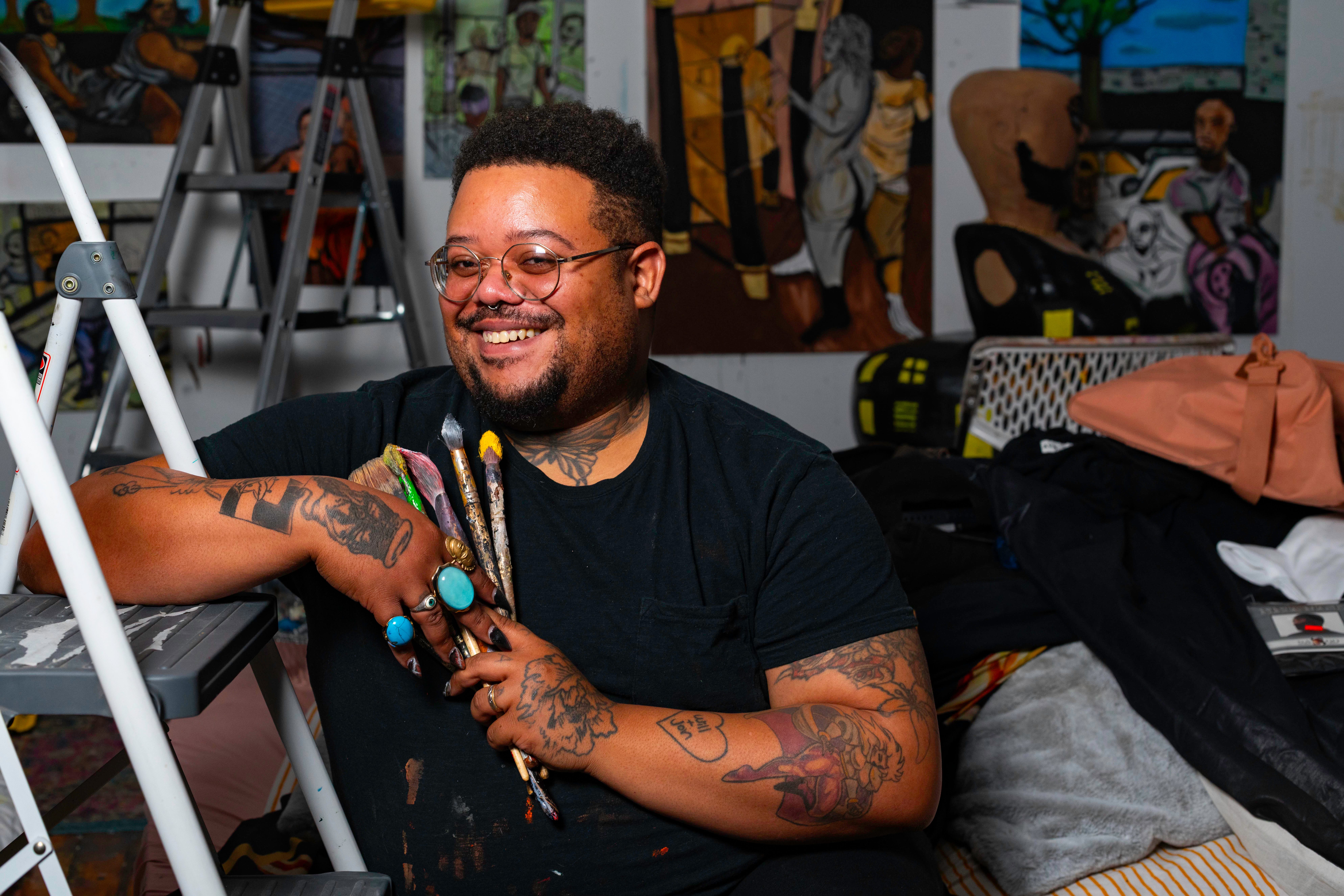
Photo Credit: Eric D. Jackson
Maleke Glee (MG): Hi Jonathan, how’s your year starting off? Any big highlights from 2025 that you’re sitting with?
Jonathan Lyndon Chase (JLC): Hi Maleke, my year is starting off very gently and promising. I’m looking forward to working on lots of new things and seeing what new things come to me both in the studio and out of the studio. I hosted quite a sizable dinner for the holidays at my home with my husband and I’m still feeling all of the warmth and love from it. It feels really good. I find myself thinking a lot about my continued collaboration with Acne Studios and the product drop and installation I did in their New York City Green Street location working with them. I learned lots of things about myself, the fashion industry, and my studio practice. It is a lot to take in so it’s taking some time.
MG: It was great to see your work presented with one of my favorite brands, Acne. I mention that collaboration often, especially to students interested in positioning their work as both fine art and fashion.
You have such a distinct style of creation across disciplines. I am curious about the approach to rendering these figures and scenes. Is there anything you can share about your approach? Everything feels like a drawing, even when it’s painted, fabric, or a sculpture form.
JLC: I draw from my everyday experiences and I take lots of photo documentation when I’m out and about, or when I’m just riding around in a car something will capture my attention— whether it’s a person, a texture, or something in nature, lots of things come to me. Also, in dreams or just spending time with my body of work and looking at the archive developed, I get lots of inspiration as a starting off point. I don’t necessarily make a drawing and then go to a painting. It can work either way. I’m always trying to play catch-up with all of the informational energy I take in, so I’m constantly drawing. I then have a system that is part digital, and part physical that I then organized things by color subject matter year and things like that.
MG: It makes sense the world is your reference; you build worlds in your work. I’ve seen your installations Big Wash (2021) at the Fabric Workshop and Museum, and his beard is soft, my hands are empty (2023) at Artist Space. Both standout as environmentally oriented. As a thespian, they remind me of sets. Do you see your work as theatrical, what is your relationship to theatre and storytelling?
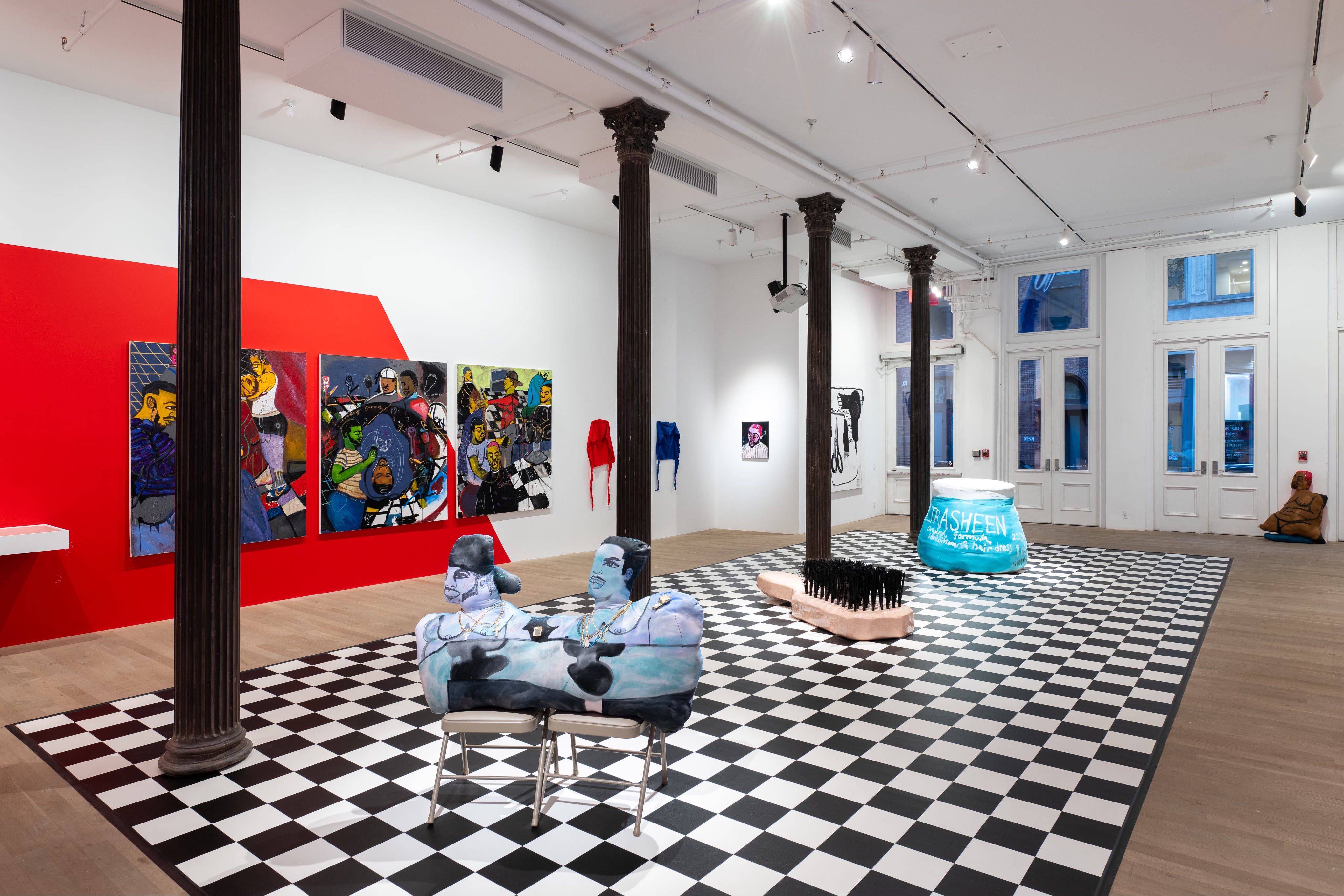
Jonathan Lyndon Chase: his beard is soft, my hands are empty. Installation view, Artists Space, 2023. Image courtesy Artists Space, New York. Photo: Filip Wolak
JLC: I don’t necessarily see my work as theatrical, but I am interested in world building that looks like reflecting the world around me and then at times I suppose it can dip into something more speculative or surreal or even horror, but I think that these are things that are already a reality is some sort of way. My work has a lot to do with body and space relationships, even though I fluctuate between figuration and abstraction somehow the lines are blurred. I’m always questioning what looks and feels real. It probably has a lot to do with me being a city person. I’m constantly surrounded by different landscapes and architecture and it has a great deal to do with being a homebody. I’m interested in systems and spaces.
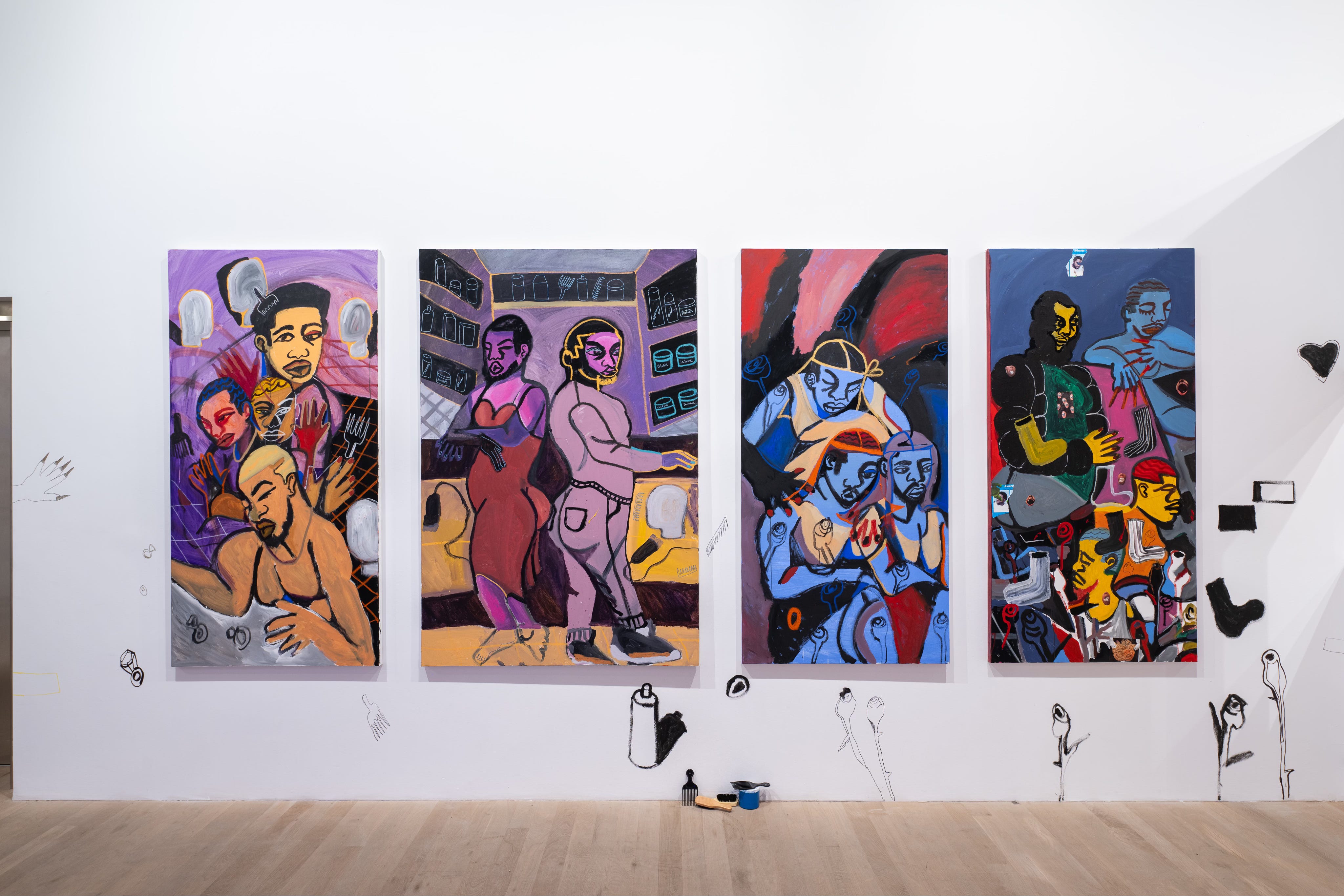
Jonathan Lyndon Chase: his beard is soft, my hands are empty. Installation view, Artists Space, 2023. Image courtesy Artists Space, New York. Photo: Filip Wolak.
MG: I love books, they also take us to new worlds. Books are also a big part of your practice. Why that format?
JLC: When I was younger and growing up, I went to the library a lot, not as much as I would like to, just mostly out of being busy, but I’m a nerd so I grew up reading lots of comic books and graphic novels in my home. I have a pretty sizable library that is still rapidly growing. There’s something about the tangibility of them and being able to write them, hold them, carry them, put them under your pillow, that really resonates with me. A part of it is accessibility, I want my work to be able to reach different audiences. At one point when I was deciding what to go to school for in college I thought I would be a writer, but I didn’t do that obviously. However, the storytelling is still very close to me and I’ve managed to develop my own approach of vocabulary. If people are interested, they should check out my book wild wild, wild West/the haunting of the seahorse that could be found through Capricious Publishing. To reference my archive, I guess I’m always sort of making books in a way and usually that’s how they start off being before they become published. It’s in its raw state.
MG: abdu and I have had some recent conversations about the need for eroticism in a digital, “X” saturated, quick nut simply a swipe away social world. The erotic poetical may be flatten in our digital world,, influencing or physical realities. There’s less presentations of alternate modes of touch. We are excited by the slower reading and process of shared pleasure. The kind of time and attention your work requests of us. You use the erotic to convey pleasure, but also to contain depths of relations and interior exploration. Does this observation resonate with you? How does the erotic inform your work?
JLC: For me, I think about how many artists, makers, actors, just people in the creative field show and express a wide range of queer black, intimacy and eroticism, and I’m talking about black love. I think it’s important for us to be the center of our own narrative and for us to continue to make worlds in the images that are not bound by respectability politics, or these notions of being good faggots, these notions of being a polite queer, I think it’s really radical in a way. Far too often do I see non-black and white creators celebrated for working in eroticism, but their privilege is negotiated in a different way again. I talk about my lived experiences lifting up what friends, lovers, and family have experienced as well. I also think that it is a part of a more subculture or niche area of sexuality in some cases, especially now that we basically have apps that can give us sex on command and us being millennials and seeing how technology has changed everything is very quick, instantaneous, and fleeting. It’s very disturbing in some ways I would say. In some ways, my drawings help me think about this idea of taking your time because I draw much slower paced than I do paint. For me, the erotic is just one of the mini expressions of queer black existence and I’m interested in showing this in a very raw way that feels real in a way that is not within a heteronormative binary.
MG: What’s one non-sexual turn-on?
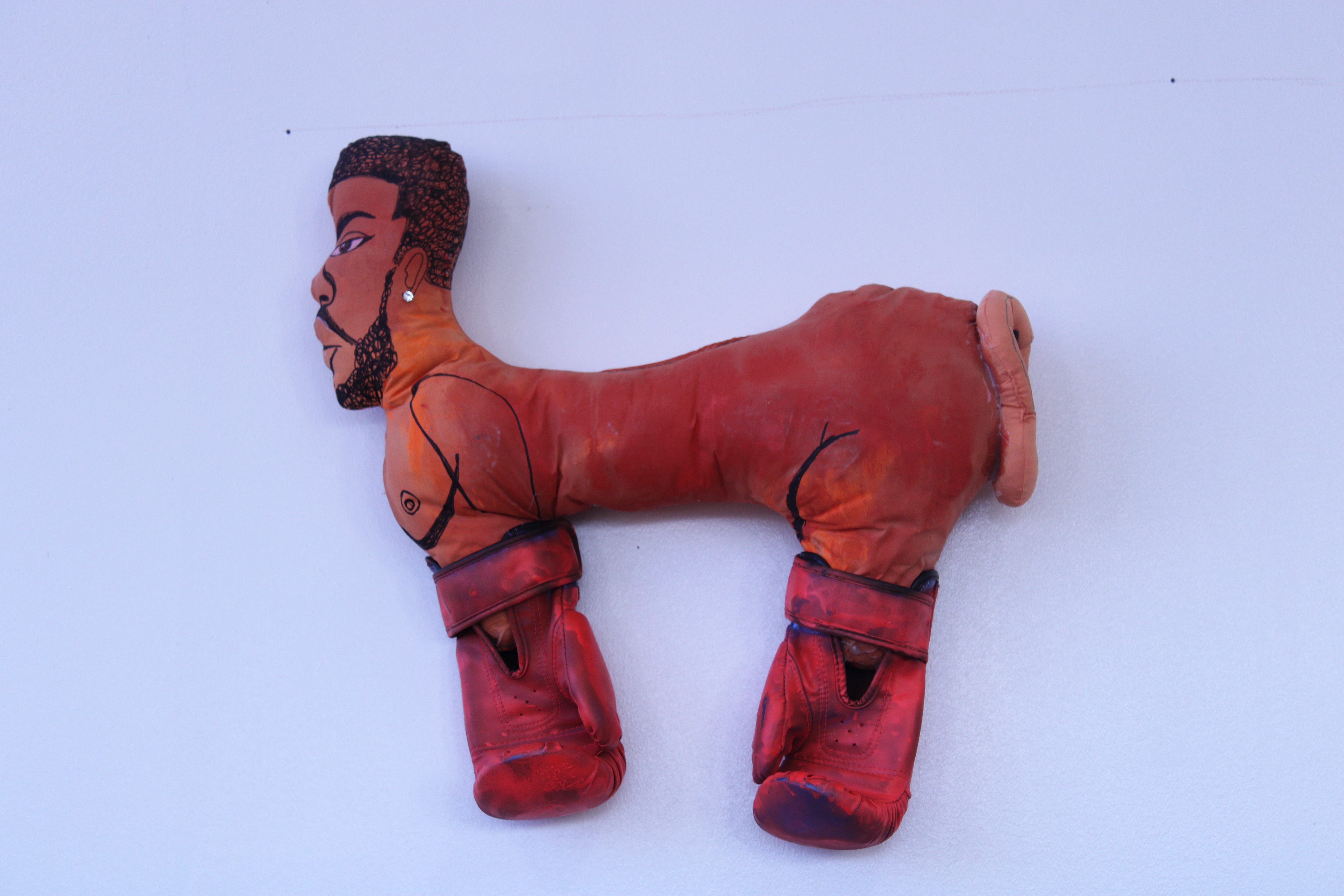
Punching bag 2, 2023, Acrylic paint poly fill thread hot glue Muslin Marker, 18” x 24”
JLC: hmmm I’m understanding and reading this question as what is a fetish of mine— boxing gloves are the first thing that popped in my head, so I’ll go with that.
MG: I’ve witnessed the collaborative, care-filled relationship with your husband, Will. What has that love opened for you in terms of expression?
JLC: Our marriage helped me learn how to love myself and how to love others more deeply. If I had not met William I don’t think that my paintings would be the same. They’re my greatest muse. They have a deep love for music and that has translated over to my love of jazz and hip-hop. We have even worked on some sound pieces together. My husband is on the autism spectrum and I live with bipolar disorder, so the way in which our minds operate makes for the best chemistry. Our love has taught me to slow down, feel more deeply to be more courageous and to unapologetically be myself, and I believe that comes through in my work.
MG: Oh, it certainly does! What other examples of Black queer love inspire your work or life?
JLC: Honestly, I think it comes from my community and my friends and our lovers. Either sharing a dinner together, cuddling on the couch, or leaning into a chest on the bed. Many stories are shared.
On our Radar
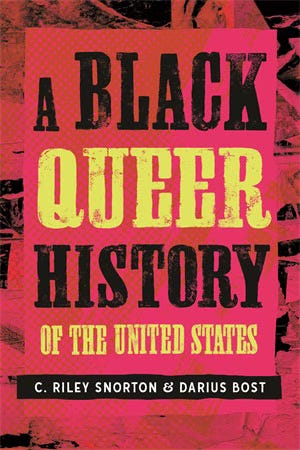
Book Release: Black Queer Histories of the United States, Riley Snorton, Darius Bost
New York, NY | February 17 | Rain Fade ft: Alexander Ghedi Weheliye, abdu ali, SCRAAATCH, Sweater on Polo, Telfar
Milan, Italy | thru March 18 | Jonathan Lyndon Chase: keep thinking nobody does it like you here comes the sunset
Baltimore, MD | February 12- March 8 | Trinity— A World Premiere
Baltimore, MD | thru February 28 | absolute alternatives
Wichita, KS | thru June 14 | Safer Waters: Picturing Black Recreation at Midcentury